Women's Yoga Socks
Best Women's Yoga Socks (2026)
Updated 2026 · 12 min read · 10 products reviewed
Disclosure: FlowMatRise is reader-supported. When you buy through links on this page we may earn an affiliate commission at no additional cost to you. Full disclosure.
Grip socks are the smallest purchase in this niche and the one most likely to change how a class feels immediately. Studio floors are engineered to be cleaned easily, which means they are smooth. Reformer carriages and footbars are smooth by necessity. A plain cotton sock on either surface is a slip waiting to happen, and going barefoot is not always an option — some studios require socks outright.
What separates a grip sock that works from one that does not comes down to four things: where the tread actually sits relative to your foot, how dense the grip pattern is, whether the sock stays put or rotates during lateral movement, and what the fabric does when it gets damp. Pack size matters more than it sounds, because grip socks live or die by laundry frequency.
The ten sets below cover the range: open-top studio-standard socks with cross-back straps, crew-height options for cold rooms, cotton-rich blends for breathability, quick-drying synthetics for heated classes, and dance-oriented patterns that deliberately allow a controlled pivot. Choose by what your class actually asks of your feet.
| Product | Best For | Key Feature | Top Con | Link |
|---|---|---|---|---|
| 1. yeuG Pilates Socks, Non-Slip Grip, 4 Pairs | A first set of grip socks for reformer or mat Pilates classes | Dense silicone tread with a cross-back strap | Open top offers no warmth | View |
| 2. kepiibi Pilates Socks with Grips, 5 Pairs | Reformer work where the toes press into a footbar | Extended toe-area grip coverage | Runs small on wider feet | View |
| 3. Ozaiic Pilates Socks, Non-Slip Grip, Breathable Cotton | Warm studios and anyone who dislikes fully synthetic socks | Breathable cotton-rich blend | Cotton stays damp longer once sweaty | View |
| 4. Muezna Pilates Grip Socks, 6 Pairs | High-frequency practitioners who want a full week of socks | Six-pair rotation pack | Looser cuff than snugger rivals | View |
| 5. Veymitour Pilates Socks, 6 Pairs, Grip Yoga Crew Socks | Cool studios, home practice in winter, and ankle coverage | Crew-height shaft with full ankle coverage | Too warm for heated classes | View |
| 6. Toes Home Pilates Socks, 4 Pairs | Home practice and wearing around the house on slick floors | Mid-weight knit with widely spaced grip dots | Less grip than a full tread pattern | View |
| 7. BKP Yoga Socks, Non-Slip Grip, for Ballet/Dance/Home | Barre, ballet-inspired classes, and anything with turns | Dance-oriented pivot-friendly grip layout | Less locked-in than Pilates-specific treads | View |
| 8. CoolMate Pilates Socks with Grips, Non-Slip | Heated classes and back-to-back sessions | Quick-drying moisture-managing blend | Holds odour if stored damp | View |
| 9. Yawlsow Pilates Grip Socks, Cute Embroidered | Gifting and lower-intensity home or studio sessions | Stitched embroidery over a standard grip layout | Raised embroidery can rub under straps | View |
| 10. BONANGEL Pilates Socks with Grips, 3 Pairs | Trying grip socks for the first time without over-committing | Three-pair starter set | Too few pairs for a frequent practice | View |
The picks in full
Considerations are shown first on every pick — the reason to hesitate is more useful than the reason to buy. Expand a section for the full case, the intended user, and how to get the most out of it.

yeuG Pilates Socks, Non-Slip Grip, 4 Pairs
Four pairs of open-top grip socks with a dense silicone tread and a heel strap — the pattern most studios would recognise as the default.
Considerations
- Open-top design offers no warmth in a cool studio
- Straps can feel tight across a high instep

kepiibi Pilates Socks with Grips, 5 Pairs
Five pairs in a set, with a grip layout that extends further toward the toes than most — useful on a reformer footbar.
Considerations
- Sizing runs slightly small for wider feet
- Thinner knit than premium grip socks
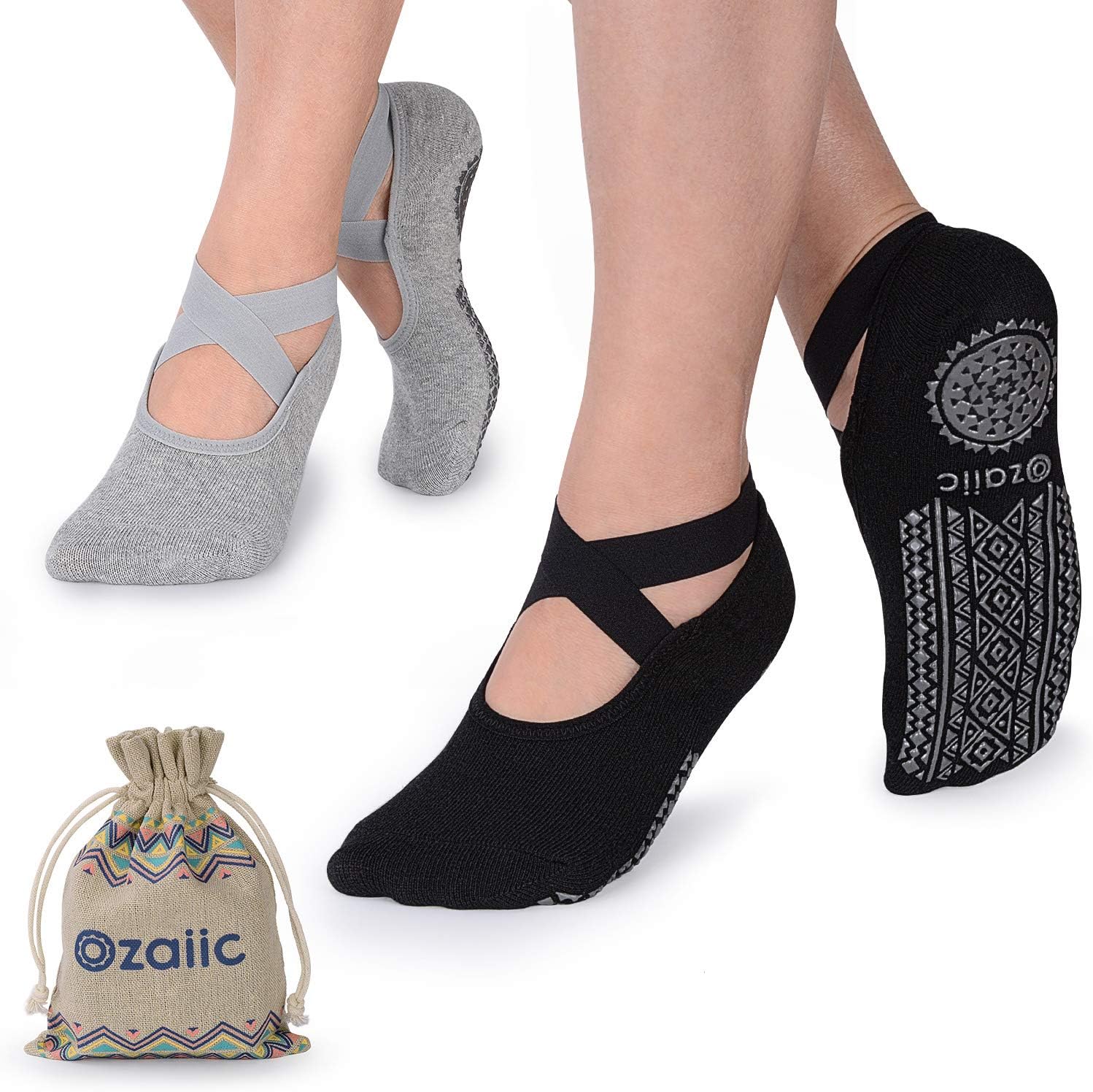
Ozaiic Pilates Socks, Non-Slip Grip, Breathable Cotton
A cotton-forward blend that breathes noticeably better than the synthetic-heavy alternatives, which matters in a warm studio.
Considerations
- Cotton absorbs sweat and stays damp longer than synthetic blends
- Slightly bulkier inside a snug shoe if you wear them to the studio

Muezna Pilates Grip Socks, 6 Pairs
Six pairs, which is the practical answer if you practise four or five times a week and would rather not think about socks again.
Considerations
- Colour assortment is fixed, so you take what comes
- Cuff is looser than the snugger options here

Veymitour Pilates Socks, 6 Pairs, Grip Yoga Crew Socks
Crew-height grip socks — the extra shaft length is the whole point if your studio runs cold or you dislike a bare ankle.
Considerations
- Crew height is warm in a heated room
- Higher shaft can bunch under tight leggings
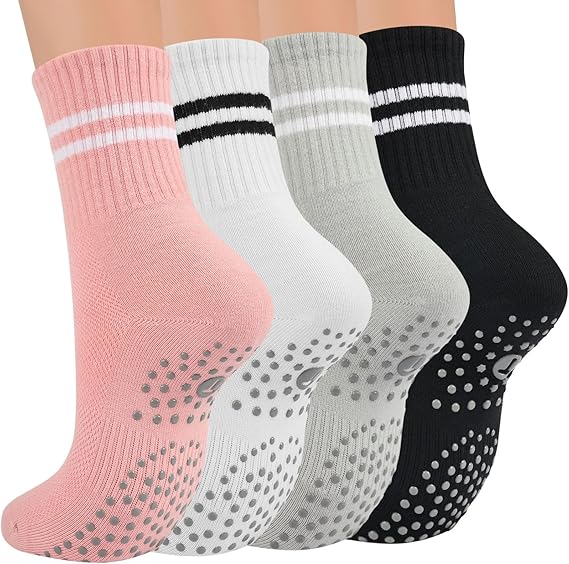
Toes Home Pilates Socks, 4 Pairs
A four-pair set with a moderately thick knit that reads as more substantial than budget grip socks without going full cushion.
Considerations
- Widely spaced dots grip slightly less than a full tread pattern
- Mid-weight knit takes longer to dry

BKP Yoga Socks, Non-Slip Grip, for Ballet/Dance/Home
Cut with dance in mind, so the profile is slimmer and the grip is arranged to allow a controlled pivot rather than lock the foot down.
Considerations
- Deliberately less locked-down than a Pilates-specific tread
- Thin knit shows wear at the toe seam sooner

CoolMate Pilates Socks with Grips, Non-Slip
A moisture-managing synthetic blend built to move sweat off the skin rather than hold it — the practical pick for a heated room.
Considerations
- Synthetic feel is less soft than a cotton-rich sock
- Holds odour if left damp in a bag overnight

Yawlsow Pilates Grip Socks, Cute Embroidered
Embroidered detailing on an otherwise conventional grip sock — a small thing, but the socks you like wearing are the socks you actually wear.
Considerations
- Embroidery on the top of the foot can rub under a tight strap
- Decorative focus means the grip is competent rather than exceptional

BONANGEL Pilates Socks with Grips, 3 Pairs
A three-pair set for testing the waters — enough to see whether grip socks change your practice before committing to a six-pack.
Considerations
- Three pairs runs out fast if you practise most days
- Fewer pairs means each one wears faster in rotation
Buying guide
Tread placement beats tread quantity
The grip pattern needs to sit under the parts of your foot that bear weight in your discipline. Mat Pilates and yoga load the ball of the foot and the heel. Reformer work loads the ball of the foot and the toes, because that is what presses into a footbar. Barre loads the ball of the foot almost exclusively and needs the heel free to pivot.
A sock with dense grip across the whole sole is not automatically better; it is heavier, less breathable, and can lock a foot down in a class where you need to turn. Check the tread photo before buying and match it to the movement you actually do. A pattern that stops short of the toes is a real problem on a reformer and irrelevant on a mat.
Straps, cuffs, and staying put
A grip sock that rotates is a grip sock with no grip, because the tread ends up on the side of your foot. Cross-back straps — the elastic band that runs over the instep — are the most effective fix and the reason most studio-standard designs have them. The trade is comfort over a high instep; if a strap has ever felt tight on you, look for a snug cuff instead of a strap.
Cuff height is about temperature and preference. Ankle-height socks are cooler and less visible under leggings. Crew height covers the ankle, stays up better through lateral movement, and becomes genuinely uncomfortable in a heated room. If your studio runs cold or you practise at home in winter, crew is worth having.
Fabric: cotton, synthetic, or a blend
Cotton-rich socks breathe better and feel softer, and they hold moisture. In a room-temperature studio that is fine. In a heated class or back-to-back sessions, a cotton sock goes clammy and the grip drops off with it. Synthetic blends move moisture off the skin and dry fast between sessions, at the cost of a slightly less pleasant hand-feel and a tendency to hold odour if left damp in a bag.
Almost all grip socks include a small amount of elastane, which is what lets them hug the foot. That elastane is also the first thing to fail — usually as a cuff that no longer stays up while the tread is still perfectly good. Washing cool and air-drying extends that considerably.
Pack size is a durability decision
A three-pair set and a six-pair set are not the same product at different scales. If you practise four or five times a week, three pairs go through the wash constantly, which means each individual pair endures far more laundry cycles per month. Heat and agitation are what kill silicone tread — not the studio floor.
Buy enough pairs that you rotate rather than repeat, and the whole set lasts disproportionately longer. Six pairs used evenly will outlive two separate three-pair purchases made a year apart.
Care: the one rule that matters
Wash inside out on a cool cycle and air dry. A tumble dryer is the single fastest way to destroy grip socks — heat softens and lifts the silicone tread, and once it starts peeling it accelerates. This is why so many people conclude that grip socks "stop working after a few months"; in most cases the dryer did it.
Store them flat rather than balled. Balling a grip sock presses tread against fabric under constant pressure, which transfers silicone onto the knit and thins the pattern over time.
Diagram
Where the tread has to sit, by discipline
| Discipline | Toes | Ball of foot | Arch | Heel | Pivot |
|---|---|---|---|---|---|
| Mat Pilates & yoga | Locked | ||||
| Reformer | Locked | ||||
| Barre & dance | Release |
More grip is not automatically better. Match the tread to the parts of the foot your discipline actually loads — and remember that barre and dance classes need a pattern that releases under a controlled pivot rather than locking the foot down.
Frequently Asked Questions
Sources and further reading
- American Council on Exercise — Pilates resources
Technique references for mat and equipment-based Pilates movements.
- Cleveland Clinic — Benefits of Pilates
Clinical overview of what Pilates training targets and who it suits.
- NIAMS — Healthy joints and injury prevention
US National Institutes of Health guidance on avoiding common movement injuries.