Yoga Mats
Best Yoga Mats (2026)
Updated 2026 · 14 min read · 10 products reviewed
Disclosure: FlowMatRise is reader-supported. When you buy through links on this page we may earn an affiliate commission at no additional cost to you. Full disclosure.
A yoga mat is the only piece of equipment that touches every single thing you do in a practice, which is why choosing one badly is so quietly expensive. The wrong thickness turns a kneeling sequence into a negotiation with your patella. The wrong surface turns downward-facing dog into a slow slide toward the wall. Neither problem announces itself in a product listing.
What follows is a working comparison of ten mats organised around the two decisions that actually matter — how much material you want between you and the floor, and what that surface does when your hands get damp. Everything else, including colour, branding, and the alignment lines printed on some mats, is downstream of those two.
We have grouped the picks so that the differences are visible rather than implied. Cushioned foam mats sit near the top because most home practitioners are working on hardwood, tile, or a thin rug and are underserved by the 3mm studio-standard mat. Thinner and wider options follow for practices that prioritise standing stability or need more room than a 24-inch mat gives. No prices appear anywhere on this page, and nothing here is a star rating.
| Product | Best For | Key Feature | Top Con | Link |
|---|---|---|---|---|
| 1. Amazon Basics Extra Thick Exercise Yoga Mat with Carrying Strap | Restorative flows, floor-based Pilates, and anyone with sensitive knees | 1/2-inch NBR foam, dual-textured faces | Too soft for stable standing balance | View |
| 2. Gaiam Thick Yoga Mat, Easy-Cinch Carrying Strap, Non-Slip NBR Foam | Home practitioners who carry a mat between rooms or to a class | One-pull cinch strap system | Initial foam odour takes days to fade | View |
| 3. CAP Barbell 1/2-Inch High Density Yoga Mat with Strap | Mixed strength-and-mobility sessions on a hard floor | High-density foam that resists bottoming out | Heavy for regular carrying | View |
| 4. Retrospec Solana Yoga Mat, 1" Thick w/Nylon Strap | Supine Pilates, rehab-style mobility work, and practising on tile or concrete | 1-inch loft for maximum joint padding | Unstable for standing balance poses | View |
| 5. Gruper Yoga Mat, Non-Slip, Eco-Friendly, 6mm | A first all-purpose mat when you do not yet know your style | 6mm all-purpose thickness | Grip drops off when damp | View |
| 6. Retrospec Solana Yoga Mat, Thick 1/2in, Nylon Strap | General home flow where standing and floor work are evenly split | Balanced 1/2-inch loft with a travel-friendly roll | Scuffs at repeated pivot points | View |
| 7. Fitvids Yoga Mat, 1/2-Inch Extra Thick High Density, Anti-Tear | Shared household mats that see heavy, careless use | Anti-tear high-density construction | Firmer underfoot than the thickness implies | View |
| 8. Gaiam Premium Yoga Mat, 6mm Thick Print Mat | A mat that stays visible in a shared living space | Printed 6mm PVC surface | PVC rather than a PVC-free material | View |
| 9. KEEP Extra Wide Yoga Mat, 7mm, 72"x32" | Taller practitioners and wide-stance standing sequences | 32-inch extra-wide surface | Too wide for standard mat bags | View |
| 10. CAP Barbell 1-Inch High Density Yoga Mat with Strap | Garage, basement, and concrete-floor practice spaces | 1-inch high-density foam for hard floors | Bulky and impractical to transport | View |
The picks in full
Considerations are shown first on every pick — the reason to hesitate is more useful than the reason to buy. Expand a section for the full case, the intended user, and how to get the most out of it.

Amazon Basics Extra Thick Exercise Yoga Mat with Carrying Strap
A half-inch NBR foam mat that behaves like a floor-work mat first and a standing-practice mat second — generous padding, textured on both faces, and forgiving on hard floors.
Considerations
- The extra loft makes balancing poses feel spongy underfoot
- NBR foam takes a permanent dent if you store it folded rather than rolled
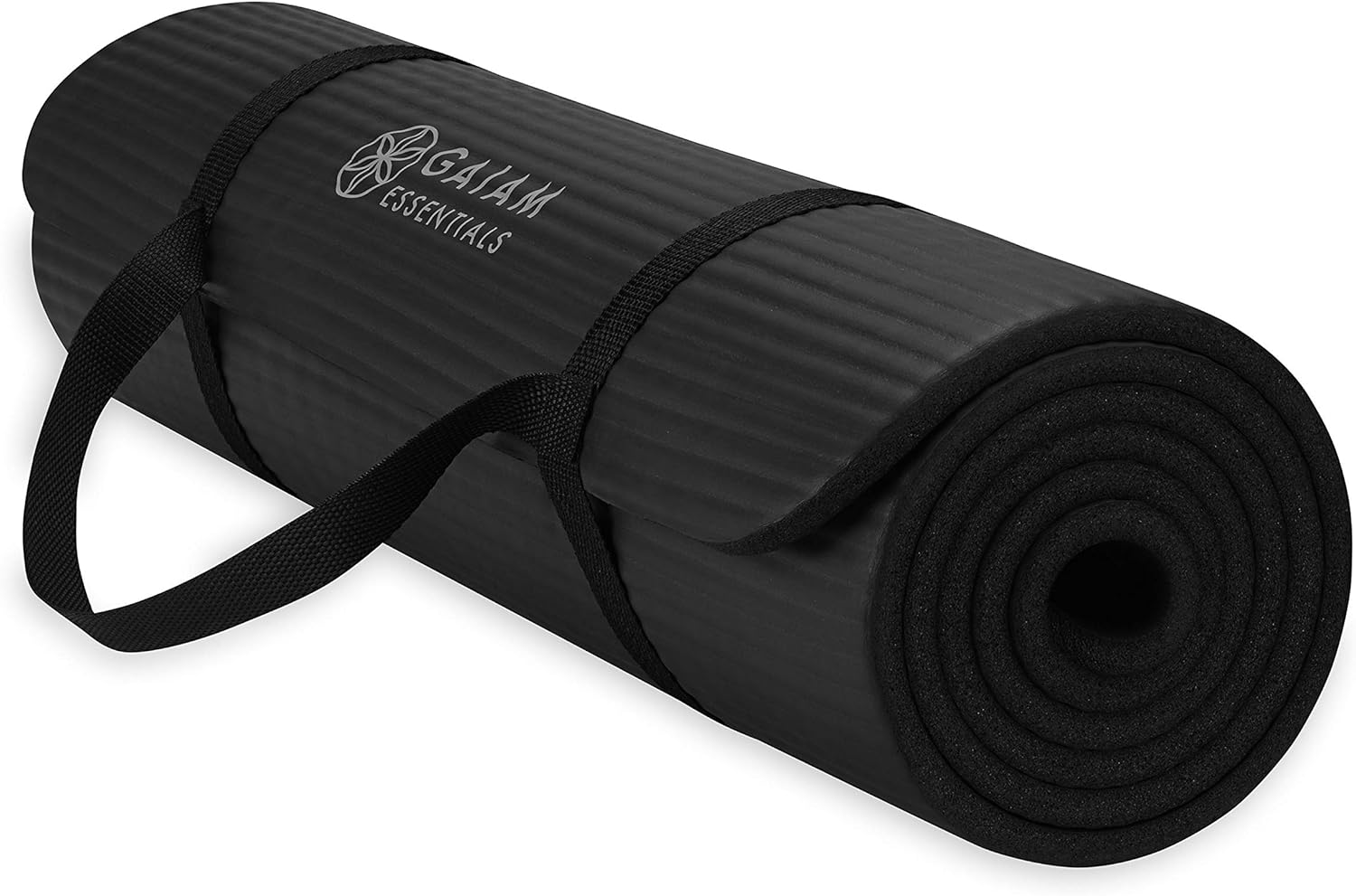
Gaiam Thick Yoga Mat, Easy-Cinch Carrying Strap, Non-Slip NBR Foam
Gaiam pairs its cushioned NBR foam with a strap that actually tightens in one pull, which sounds trivial until you are carrying a fat mat across a parking lot.
Considerations
- Foam gives off a noticeable smell for the first week or two
- Edges can lift slightly on plush carpet during dynamic transitions

CAP Barbell 1/2-Inch High Density Yoga Mat with Strap
A denser half-inch mat aimed at people who do as much strength work as stretching, so it resists bottoming out under an elbow or a knee.
Considerations
- Heavier than comparable mats, which discourages daily transport
- Surface prefers bare feet — socks slide on it more than expected

Retrospec Solana Yoga Mat, 1" Thick w/Nylon Strap
A full inch of foam — closer to a mobility pad than a yoga mat, and exactly right if the floor is the problem you are solving.
Considerations
- Standing balance work is genuinely unstable at this thickness
- Bulky roll takes up serious closet or car-boot space

Gruper Yoga Mat, Non-Slip, Eco-Friendly, 6mm
Six millimetres is the compromise thickness most practices actually want, and this one keeps the surface texture assertive enough to matter.
Considerations
- Grip fades noticeably once the surface gets damp
- Colour transfer onto light-coloured leggings has been reported early on

Retrospec Solana Yoga Mat, Thick 1/2in, Nylon Strap
The half-inch sibling of the Solana line — the same foam and strap, dialled back to a thickness that still lets you feel the floor.
Considerations
- Foam surface scuffs where a heel pivots repeatedly
- Not textured enough for sweaty-palm sequences

Fitvids Yoga Mat, 1/2-Inch Extra Thick High Density, Anti-Tear
Marketed around tear resistance, and that is the right frame: this is a mat for households where the mat gets dragged, stepped on, and shared.
Considerations
- Firmer feel than the loft suggests — less plush than it looks
- Slippery under damp hands, like most NBR surfaces

Gaiam Premium Yoga Mat, 6mm Thick Print Mat
Gaiam’s printed 6mm PVC mat — the one you buy when the mat lives in the corner of a living room and has to look like it belongs there.
Considerations
- PVC is not the choice if you specifically want a latex-free, PVC-free mat
- Print can help you notice wear, which some people find distracting

KEEP Extra Wide Yoga Mat, 7mm, 72"x32"
Thirty-two inches wide instead of the usual twenty-four — the single change that fixes practice for taller bodies and wide-stance sequences.
Considerations
- Will not fit a standard mat bag or most studio cubbies
- The wider roll is awkward to carry one-handed

CAP Barbell 1-Inch High Density Yoga Mat with Strap
A one-inch high-density mat that sits between a yoga mat and a gym pad — the practical answer to a concrete garage floor.
Considerations
- Bulk and weight rule it out as a portable mat
- Overkill for a practice that is mostly standing
Buying guide
Thickness is a trade, not an upgrade
Every millimetre of foam you add takes stability away from standing poses and gives it back to your knees, elbows, and spine. There is no thickness that wins everywhere. A 3mm travel mat lets you feel exactly where your weight sits in tree pose and will punish a twenty-minute kneeling sequence. A one-inch mobility pad makes supine work luxurious and makes half-moon feel like standing on a mattress.
The useful question is not "what is the best thickness" but "which failure would end my session sooner?" If your practice is mostly standing and balancing — a vinyasa flow, a hatha class — sit at 4mm to 6mm. If your practice is mostly on the floor — Pilates mat work, restorative, rehab homework, anything with a lot of kneeling — go to half an inch and accept softer balance. If you genuinely do both in equal measure, owning two mats is cheaper than most people assume and eliminates the compromise entirely.
Grip is a material property, not a texture claim
Almost every mat listing promises non-slip. What differs is what "non-slip" means when moisture is involved. Closed-cell surfaces — most PVC and NBR foam — repel sweat, which keeps them hygienic but means moisture sits on top and acts as a lubricant. Open-cell surfaces absorb, so they grip better as you warm up but need proper cleaning and drying.
For a mostly-dry home practice in a room-temperature space, a closed-cell foam mat with a pronounced texture is perfectly adequate and much easier to keep clean. For a warm room, a heated class, or a practice where your hands sweat regardless of temperature, no closed-cell mat will solve the problem on its own — a cotton mat towel across the top third does, and costs a fraction of a premium grip mat. Buying a more expensive mat to fix a sweat problem is one of the most common mistakes in this category.
Material: NBR, PVC, TPE, and what actually differs
NBR foam is the cushioned, lightweight material behind most thick mats. It is comfortable, cheap, and takes a permanent compression set if stored folded. PVC is denser, more durable, and grips more predictably when dry, but it is a plastic some people specifically want to avoid. TPE sits between them — lighter than PVC, more resilient than NBR, generally more expensive.
None of these are dangerous in normal use, and all three off-gas a noticeable smell when new. That smell fades within one to two weeks of airing out unrolled; it is not a defect and it is not a sign of a bad mat. If a mat still smells strongly after a month of open-air storage, that is a different conversation.
Latex-free matters only if you have a latex sensitivity, in which case check the listing explicitly — natural rubber mats are excellent performers and completely unsuitable for that group.
Size, and why 24 inches is not a law of nature
The standard mat is 68 by 24 inches, a size chosen decades ago and repeated ever since. If you are over about 5'10", your hands or heels leave the mat in half the poses you do, and you spend the class subtly shortening your stance to stay on the surface. That is not a discipline problem; it is a sizing problem.
Extra-long (72-inch) and extra-wide (32-inch) mats fix this and cost very little more. The trade is portability — a 32-inch mat will not fit a standard mat bag or a studio cubby. If your mat lives at home, that trade is free. If you carry it to class, it is not.
Care that actually extends a mat’s life
Roll, never fold. Store away from direct sunlight and radiators, both of which degrade foam and vinyl. Clean with a damp cloth and a drop of mild soap, or a diluted white vinegar solution; skip alcohol wipes and harsh disinfectants, which strip the surface and leave it slick. Let it dry fully unrolled before storing.
Rotate the mat end-for-end every few weeks. Most mats fail at the two spots where your feet pivot most, and rotating spreads that wear across four spots instead of two. It is the single cheapest thing you can do to double the life of a foam mat.
Diagram
The thickness trade: floor feel against joint padding
2-3mm
Travel
4-5mm
Studio standard
6mm
All-purpose
10-12mm
Floor work
25mm
Mobility pad
Every millimetre you add moves the mat down the stability axis and up the padding axis. There is no thickness that maximises both, so the choice is really a question about which failure would end your session first.
Frequently Asked Questions
Sources and further reading
- Harvard Health Publishing — Yoga for better health
Overview of the physical and cognitive effects associated with a regular yoga practice.
- Mayo Clinic — Yoga: Fight stress and find serenity
Clinical perspective on safe practice and who should check with a clinician first.
- NCCIH — Yoga: What you need to know
US National Center for Complementary and Integrative Health summary of the evidence base.